
Fastest 3D printers (by real volumetric flow)
Updated 16 October 2026 · Live prices updated daily
Printers that actually deliver on the "fast" marketing, judged by volumetric flow rate in mm³/s - not headline toolhead speed. 20 mm³/s+ puts you in legitimately fast territory.
- #1
 phrozenArco FDM$900 CoreXY · 27.0 L · 300°C
 - #2
 CrealityK2 Plus$1003 CoreXY · heated chamber · 42.9 L · 350°C · Strain gauge
 - #3
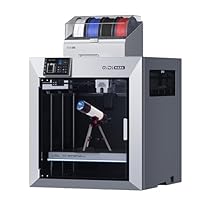 R QIDI TECHNOLOGYQIDI Max4$1299 CoreXY · heated chamber · 51.7 L · 370°C · Loadcell Sensor Integrated int
 - #4
 FLASHFORGECreator 5 Pro Industrial$849 CoreXY · heated chamber · 16.8 L · 320°C · Fully Automatic Calibration &
 - #5
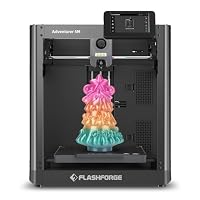 FLASHFORGEAdventurer 5M$249 CoreXY · 10.6 L · 280°C · Automatic
 - #6
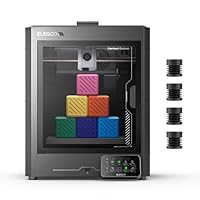 ELEGOOCentauri Carbon$290 CoreXY · 16.8 L · 320°C · Auto-leveling
 - #7
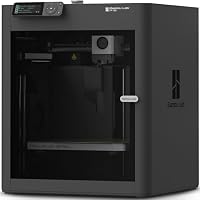 BAMBULABBambu Lab P1S$399 CoreXY · 16.8 L · 300°C · Strain gauge
 - #8
 CrealityK1 Max$481 CoreXY · 27.0 L · 300°C · AI LiDAR
 - #9
 FLASHFORGECreator 5 Multi-Toolhead 7S Toolchanger Mu$699 CoreXY · 16.8 L · 320°C · Fully Automatic Calibration &
 - #10
 BAMBULABBambu Lab A1 mini + LED Lamp$249 Bedslinger · 5.8 L · 300°C · Strain gauge
No listings match your current marketplace selection - tick more sources above.
Matt's take
Every printer advertises a top speed in mm/s. Those numbers are motion-system limits, not print limits. The real constraint on how fast a layer can extrude is the hot end's volumetric flow rate - how many cubic millimetres of molten plastic it can push per second. A 500 mm/s bedslinger with a 10 mm³/s hot end will print at ~180 mm/s on any real part. A CoreXY with 28 mm³/s will sustain 300 mm/s+ on the same part. Read volumetric flow, ignore everything else marketing tells you about speed.
Frequently asked
What is volumetric flow rate and why does it matter? +
It is how much plastic the hot end can melt per second, measured in mm³/s. It is the real-world speed limit on any FDM print. A printer advertising 500 mm/s with only 10 mm³/s of flow will print real parts at about a third of that figure.
What is a good volumetric flow for a 3D printer? +
10 mm³/s is entry. 15-20 mm³/s is mid-tier. 25+ mm³/s is genuinely fast. Bambu X1C, Creality K1/K2, Qidi X series land in the 25-32 mm³/s range. Anything claiming 40+ is either a specialty high-flow nozzle or marketing hyperbole.
Will a fast printer ruin my print quality? +
Only if the frame is not rigid enough or input shaping is not dialled in. A cheap CoreXY running fast gets ringing; a well-tuned Prusa MK4S or Bambu X1C stays clean. Rigid frames, input shaping and decent cooling matter more than motion kinematics alone.
Related reading
Ranking is spec-driven. It favours printers that objectively have the capabilities this shortlist targets. Firmware, support quality and long-term reliability aren't on the spec sheet - read the full printer page and owner reports before committing.
