
Best 3D printers with high-temp heated beds
Updated 16 October 2026 · Live prices updated daily
Printers whose heated bed clears 100 °C. Essential for reliable ABS, ASA and PA-CF adhesion without lifting corners.
- #1
 QIDI TECHQIDI MAX4£959 CoreXY · heated chamber · 51.7 L · 370°C · Loadcell Sensor Integrated int
 - #2
 QIDI TECHQIDI MAX4 & QIDI Box Multi-Colour System£1019 CoreXY · heated chamber · 51.7 L · 370°C · Loadcell Sensor Integrated int
 - #3
 ANYCUBICKobra S1 Max£800 CoreXY · heated chamber · 42.9 L · 350°C · LeviQ 3.0
 - #4
 QIDI TECHQIDI Plus5 Multi-Color£769 CoreXY · heated chamber · 30.7 L · 370°C · Loadcell
 - #5
 VoxelabFLASHFORGE Creator 5 Pro Industrial£749 CoreXY · heated chamber · 16.8 L · 320°C · Fully Automatic Calibration &
 - #6
 SovolSV08 Max 500x500x500mm CoreXY 700mm/s Eddy£809 CoreXY · 125.0 L · 300°C · Eddy Current Scanning
 - #7
 CrealityK2 Plus£1780 CoreXY · heated chamber · 42.9 L · 350°C · Strain gauge
 - #8
 ORIGINAL PRUSACORE One+ FULL - Professional High-Speed£1069 CoreXY · heated chamber · 14.8 L · 290°C · Load cell
 - #9
 CrealityK2 Plus Multi 16 Colors Printing£962 CoreXY · 42.9 L · 350°C · Strain gauge
 - #10
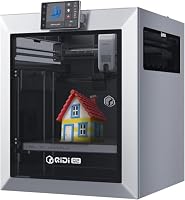 QIDI TECHQIDI Q2£429 CoreXY · 18.7 L · 370°C
No listings match your current marketplace selection - tick more sources above.
Matt's take
Bed temperature is the quiet spec that separates "can print ABS if you cross fingers" from "prints ABS reliably". Most PLA-focused machines top out at 70-80 °C because that is all PLA needs. ABS wants 100-110 °C, ASA similar, and filled nylons 90-110 °C. Without that bed heat, corners peel as the print cools and you end up running a brim or raft on every part. Pair with an active heated chamber for best results - bed heat alone helps but doesn't fully solve warp on tall ABS.
Frequently asked
Do I need a 100 °C heated bed? +
Only if you print ABS, ASA, or filled nylons. PLA and PETG are happy at 60-80 °C. If you never leave PLA territory, a high-temp bed is unused capability.
Why does bed temperature matter for ABS? +
ABS shrinks as it cools from its 100 °C+ print temperature. A hot bed keeps the bottom layers near glass transition, so the shrink happens gradually rather than snapping the print off the plate at hour three.
Is a garolite/FR4 bed surface different from PEI? +
Garolite is the de-facto surface for nylon because nylon refuses to stick to PEI. If you plan to print nylon, check that the printer either ships a garolite plate or accepts a swap-in one. Otherwise it is an extra £30 and often an extra week's wait.
Related reading
Ranking is spec-driven. It favours printers that objectively have the capabilities this shortlist targets. Firmware, support quality and long-term reliability aren't on the spec sheet - read the full printer page and owner reports before committing.
